


Why Use Licensed Contractors in Ontario Homes
Most Canadian homeowners are surprised to learn that working with an unlicensed contractor can make their insurance claims up to four times more likely to be denied. In Durham Region and Northumberland County, choosing a licensed professional is about more than just following the rules. It ensures that your renovation project is managed safely, backed by legal protection, and completed to high standards. Discover how the right Canadian contractor brings peace of mind and long-term value to your home.
Key Takeaways
| Point | Details |
|---|---|
| Licensed Contractors Ensure Safety | Hiring licensed contractors in Ontario guarantees adherence to strict safety and legal standards, reducing risks for homeowners. |
| Specialised Licences Available | Contractors in Ontario hold various specialised licences, ensuring they possess the essential skills for specific construction tasks. |
| Importance of Verification | Homeowners should always verify a contractor’s licensing status and credentials to avoid potential financial and safety risks. |
| Consequences of Hiring Unlicensed Contractors | Engaging unlicensed contractors can lead to severe consequences, including financial liability and subpar construction quality. |
Licensed Contractors Defined in Ontario
In Ontario, licensed contractors represent skilled professionals who play a critical role in residential construction and renovation projects, operating within a structured regulatory framework designed to protect homeowners and ensure high-quality workmanship. The New Home Construction Licensing Act establishes comprehensive guidelines that define these professionals, mandating specific competency and ethical standards for anyone undertaking construction work.
Under Ontario law, licensed contractors must demonstrate professional expertise by meeting rigorous requirements set by provincial regulatory authorities. These requirements include proving technical competence, maintaining appropriate insurance coverage, and adhering to the Ontario Building Code. Contractors must also comply with health and safety regulations outlined in the Occupational Health and Safety Act, which governs their responsibilities during construction projects.
The licensing process involves multiple verification steps to ensure contractors possess the necessary skills and integrity. Professionals must typically complete formal training, pass professional examinations, provide proof of relevant experience, and maintain ongoing professional development. This multi-stage verification process helps protect homeowners by ensuring only qualified individuals can legally perform residential construction and renovation work in Ontario.
Pro tip: Before hiring a contractor, always request and independently verify their current Ontario licensing credentials to confirm their legal authorization to perform construction work in your specific region.
Types of Contractor Licences Explained
In Ontario, contractor licences are not a one-size-fits-all designation but rather a nuanced system of specialized certifications tailored to different construction and trade specialities. These licences encompass various categories that reflect the complexity and specific requirements of residential and commercial construction work, ensuring that professionals possess the precise skills needed for their particular domain.
The provincial licensing framework includes several key categories of contractor certifications. General Contractors typically hold broad permissions for managing entire construction projects, while Specialized Trade Contractors focus on specific areas such as electrical, plumbing, carpentry, or HVAC installations. Each category requires unique qualifications, with professionals needing to demonstrate specialized knowledge through comprehensive training, examinations, and ongoing professional development. Homeowners can verify contractor licence requirements using Ontario’s BizPaL tool, which provides detailed information about specific licensing and permit needs for different types of construction work.
Most contractor licences in Ontario involve rigorous qualification processes that include technical examinations, proof of practical experience, and mandatory insurance coverage. Electricians, plumbers, and other trades with direct impact on safety must complete additional certification steps, including provincial apprenticeship programs and specialized technical training. These stringent requirements help protect homeowners by ensuring that only highly qualified professionals can legally perform critical construction and renovation work.
Pro tip: Always confirm a contractor’s specific licence category and validate its current status through official Ontario provincial registers before committing to any construction project.
Here’s a summary comparison of the main categories of contractor licences in Ontario:
| Licence Category | Typical Projects | Key Qualifications |
|---|---|---|
| General Contractor | Entire home builds or major renovations | Broad construction management skills, insurance, experience |
| Electrical Contractor | Wiring, panel upgrades, safety systems | Completion of apprenticeship, technical examination, WSIB registration |
| Plumbing Contractor | Installations, repairs, water systems | Provincial certification, technical training, insurance |
| HVAC Contractor | Heating, cooling installations, ventilation | Specialised trade training, code compliance, ongoing certification |
Key Legal and Safety Requirements
In Ontario, contractors are bound by a comprehensive legal framework designed to protect both workers and homeowners through rigorous safety and professional standards. The Occupational Health and Safety Act establishes critical guidelines that mandate extensive safety protocols, requiring contractors to develop site-specific safety policies, maintain detailed documentation, and ensure comprehensive worker protection throughout construction projects.

Licensed contractors must navigate a complex landscape of legal requirements that extend beyond basic safety considerations. Workplace Insurance is mandatory, with contractors required to register with the Workplace Safety and Insurance Board (WSIB) to provide essential worker protections. Specific trades, such as electrical contractors, face even more stringent regulations. Electrical contractors must comply with precise safety standards outlined in the Electricity Act and Ontario Regulation 570/05, which dictate everything from permit acquisition to technical installation requirements.
The legal framework for contractors in Ontario encompasses multiple layers of compliance, including adherence to the Ontario Building Code, maintaining appropriate insurance coverage, and demonstrating ongoing professional competence. Contractors must consistently prove their ability to meet technical standards, safety requirements, and ethical business practices. Failure to comply can result in severe consequences, including licence suspension, financial penalties, and potential legal action that could permanently damage a contractor’s professional reputation.
Pro tip: Request documentation of a contractor’s WSIB clearance and current insurance coverage before signing any construction contract to protect yourself from potential liability.
Ensuring Quality and Accountability
Quality and accountability in Ontario’s construction industry are meticulously monitored through comprehensive tracking systems designed to protect homeowners and maintain professional standards. The Ontario Builder Directory provides an essential resource for verifying contractor credentials, enabling consumers to research a contractor’s history, regulatory compliance, and professional track record before engaging their services.
Regulatory bodies in Ontario impose stringent accountability measures across different trade specialities. Electrical contractors, for instance, must adhere to extremely precise standards of conduct. Contractors are subject to regular audits and must demonstrate ongoing integrity through comprehensive insurance coverage, professional documentation, and compliance with provincial safety regulations. These systematic checks ensure that only highly qualified professionals can operate in the construction and renovation marketplace.
Accountability extends beyond initial licensing, requiring continuous professional development and adherence to evolving industry standards. Contractors must maintain current certifications, participate in ongoing training programs, and consistently demonstrate technical competence. Regulatory authorities can suspend or revoke licences for repeated violations, creating a powerful incentive for contractors to maintain exceptional performance standards and prioritize client satisfaction throughout every project.
Pro tip: Always cross-reference a contractor’s credentials using multiple sources, including the Ontario Builder Directory and trade-specific regulatory websites, to verify their current standing and professional reputation.
Risks of Unlicensed Contractors
Hiring unlicensed contractors exposes homeowners to significant financial and safety risks that can far outweigh any potential short-term cost savings. Unlicensed electrical work, for instance, can lead to substantial fines and dangerous installation practices, creating a potentially catastrophic scenario for unsuspecting property owners who may face serious legal and structural consequences.
Insurance complications represent one of the most critical dangers associated with unlicensed work. Homeowners who engage unlicensed contractors risk complete denial of insurance claims if accidents or damage occur, leaving them financially vulnerable. Statistically, unlicensed work is up to four times more likely to result in safety issues, with homeowners potentially held personally liable for injuries or property damage that stem from non-compliant renovations.
The risks extend beyond immediate financial exposure. Unlicensed contractors often lack the technical knowledge, professional training, and understanding of current building codes required to perform high-quality work. This knowledge gap can result in substandard installations, structural weaknesses, and potential long-term damage that may not become apparent until significant repair costs are necessary. Moreover, without proper licensing, homeowners have limited legal recourse if disputes arise or if the work fails to meet basic professional standards.
Pro tip: Always request and independently verify a contractor’s current licence number with provincial regulatory bodies before allowing any work to commence on your property.
Comparing Licenced and Unlicensed Services
The fundamental distinction between licensed and unlicensed contractors lies in their professional credentials, legal standing, and commitment to quality. Licensed contractors in Ontario are authorized by provincial authorities to perform regulated work, carrying comprehensive liability insurance and adhering to strict building codes that protect homeowners from potential risks associated with substandard construction practices.
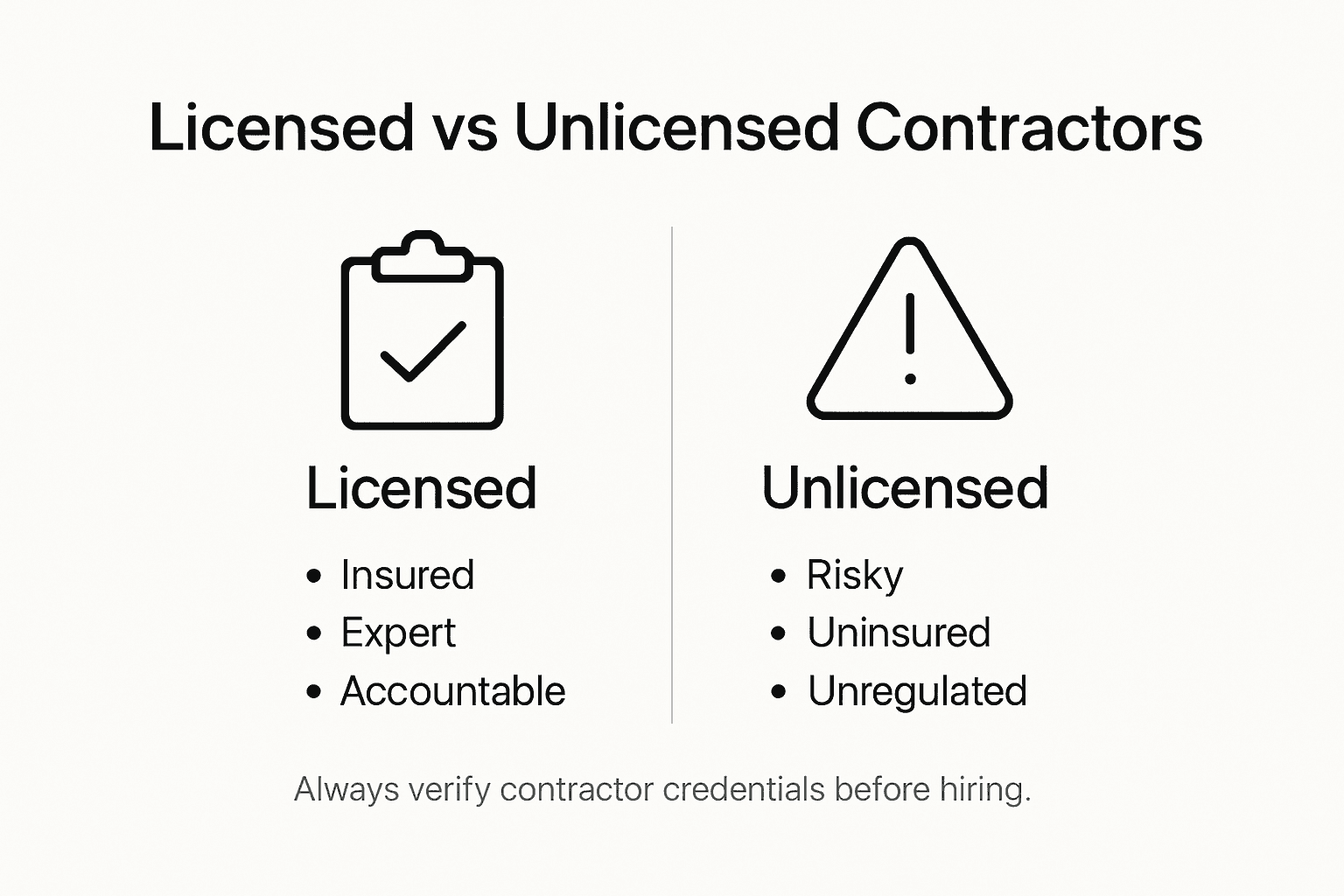
Professional Accountability represents a critical differentiator between licensed and unlicensed services. Regulated builders must demonstrate competency and follow precise oversight standards established by agencies like the Home Construction Regulatory Authority. Licensed contractors are required to maintain ongoing professional certifications, participate in continuous training, and meet stringent performance benchmarks. Unlicensed contractors, by contrast, operate without these mandatory quality controls, leaving homeowners vulnerable to potential technical errors, safety violations, and long-term structural complications.
Financial implications further underscore the importance of choosing licensed professionals. While unlicensed contractors might offer lower initial pricing, the potential long-term costs can be substantially higher. Licensed contractors provide transparent pricing, comprehensive warranties, and legal recourse in case of disputes. Their work is backed by professional insurance, meaning homeowners are protected against potential installation errors, structural deficiencies, or accidents that might occur during renovation projects. Unlicensed services typically lack these financial safeguards, potentially exposing homeowners to significant out-of-pocket repair expenses and legal complications.
Pro tip: Request a detailed comparison of licensed versus unlicensed contractor credentials, including insurance documentation and professional certifications, before making any final hiring decisions.
This table highlights the key differences between licensed and unlicensed contractors:
| Aspect | Licensed Contractor | Unlicensed Contractor |
|---|---|---|
| Legal Authority | Authorised by provincial bodies | No legal authority to operate |
| Insurance | Liability and WSIB coverage mandatory | No requirement, often uninsured |
| Consumer Protection | Warranties, dispute recourse available | Limited or no protection |
| Skill Verification | Proven training and certification | No provincial validation |
| Consequences for Non-Compliance | Licence suspension, fines | Possible fines, legal action, project shutdown |
Choose Licensed Experts for Your Ontario Home Projects
Navigating Ontario’s strict construction regulations and safety requirements can feel overwhelming. Hiring unlicensed contractors puts your home and investment at risk through potential code violations, uninsured work, and lack of accountability. At Henley Contracting, we understand these challenges and prioritize licensed, insured professionals who comply with provincial licensing laws and safety standards. Whether you are planning a full custom home or targeted renovation, our team brings over three decades of trusted experience across Durham, Kawartha Lakes, and Northumberland County.
Why risk costly mistakes when you can work with proven experts who deliver quality and peace of mind Our dedicated specialists ensure compliance with Ontario’s building codes and licensing requirements so that your project proceeds smoothly and safely every step of the way. Explore our comprehensive services from Custom Build to Renovations.

Secure your dream home with licensed professionals who value your safety and satisfaction. Visit Henley Contracting today to discover how we combine local expertise with regulatory compliance. Contact us now to get started on your project without the risks of unlicensed work.
Frequently Asked Questions
What are the benefits of hiring licensed contractors for home projects?
Hiring licensed contractors ensures compliance with safety regulations, provides liability insurance protection, and guarantees a level of professionalism and quality workmanship that unlicensed contractors may not deliver.
How can I verify if a contractor is licensed in Ontario?
Homeowners can verify a contractor’s licensing status through the Ontario Builder Directory or by using the BizPaL tool to check specific licensing and permit requirements for various types of construction work.
What are the risks of hiring unlicensed contractors?
Hiring unlicensed contractors can lead to financial losses, lack of insurance coverage, substandard work, and potential legal issues, including denial of insurance claims if problems arise.
What types of licenses do contractors hold in Ontario?
Contractors in Ontario hold various licenses, including General Contractors for overall project management, Electrical Contractors for wiring and safety systems, Plumbing Contractors for water system installations, and HVAC Contractors for heating and cooling systems.


