
Role of General Contractor – Impact on Durham Homes
Hiring the right general contractor is one of the most important decisions for Durham Region homeowners planning custom builds or major renovations. With the average Canadian home renovation project now exceeding $20,000, making a smart choice can protect your investment and increase property value. Understanding the real scope of a general contractor’s role helps you avoid costly mistakes, ensures compliance with Ontario regulations, and sets your project up for long-term success.
Key Takeaways
| Point | Details |
|---|---|
| Role of General Contractors | General contractors manage every phase of residential construction, ensuring quality, safety, and efficient communication between teams. |
| Types of Contractors | Various types exist, such as operative builders and design-build firms, each specialising in different aspects of construction and renovation. |
| Legal Requirements | Contractors must meet stringent licensing and safety compliance standards to protect homeowners and ensure professional integrity. |
| Financial Management | Homeowners should establish clear payment terms and maintain a contingency budget to mitigate the risks of unexpected costs and project delays. |
Defining the Role of a General Contractor
A general contractor serves as the central orchestrator of residential construction and renovation projects in Durham, managing complex building initiatives from initial planning through final completion. Contractors hold critical responsibilities for coordinating multiple teams, ensuring project quality, and maintaining safety standards throughout the construction process.
In practical terms, general contractors function as project managers who oversee every aspect of home building or renovation. They coordinate subcontractors like electricians, plumbers, carpenters, and painters, ensuring each professional completes their work according to precise specifications, building codes, and project timelines. The contractor acts as a crucial communication hub, translating architectural plans into actionable steps and managing the intricate workflow required to transform design concepts into physical structures.
The comprehensive scope of a general contractor’s role extends well beyond basic coordination. Construction managers contribute early design input to enhance project constructability, helping identify potential challenges before construction begins. This proactive approach allows homeowners to benefit from expert insights that can reduce potential risks, control costs, and streamline the entire building process. By leveraging their extensive knowledge of construction techniques, materials, and local building regulations, general contractors provide homeowners with a comprehensive solution that simplifies complex renovation and construction projects.
Pro Tip: Before hiring a general contractor, always request a detailed portfolio of previous projects and verify their professional credentials to ensure they have specific experience with residential construction in the Durham Region.
Types of General Contractors in Residential Projects
In the Durham Region’s residential construction landscape, general contractors are not a one-size-fits-all professional category. Residential building contractors vary significantly in their specialties, scope of work, and project management approaches. These professionals can be broadly categorized into several distinct types, each bringing unique skills and expertise to home construction and renovation projects.
The primary types of general contractors include operative builders, who directly handle construction work, and design-build firms that integrate architectural design with construction management. Some contractors specialize in specific project scales, ranging from single-family home construction to multi-unit residential developments. Construction trade supervisors may also focus on specific trades like bricklaying, roofing, insulating, or painting, bringing deep expertise in particular aspects of residential building.
Within the Durham Region, general contractors can be further classified by their service offerings. Some focus exclusively on new home construction, while others specialize in home renovations, additions, or custom builds. Remodeling contractors, for instance, concentrate on transforming existing spaces, updating kitchens, bathrooms, and living areas to meet modern homeowner needs. Custom home builders, by contrast, work closely with architects and homeowners to create entirely new residential structures tailored to specific design preferences and lifestyle requirements.
Here is a comparison of common types of general contractors and their core specializations:
| Contractor Type | Primary Focus | Typical Projects |
|---|---|---|
| Operative Builder | Direct construction management | Single-family homes, small renos |
| Design-Build Firm | Integrated design & build | Custom homes, major remodels |
| Trade Supervisor | Oversight of specific trades | Roofing, masonry, painting projects |
| Remodeling Contractor | Space transformation | Kitchen, bathroom, interior upgrades |
| Custom Home Builder | Bespoke house construction | High-end, architect-led designs |
Pro Tip: When selecting a general contractor, carefully review their specific specialization and past project portfolio to ensure their expertise aligns precisely with your unique residential construction or renovation needs.
How General Contractors Manage Construction Workflows
Managing construction workflows represents a complex choreography of planning, coordination, and precise execution. Construction planning involves strategic task identification that requires meticulous attention to resource allocation, operational sequencing, and ongoing progress monitoring. General contractors must navigate multiple interconnected elements simultaneously, ensuring each project phase transitions smoothly and efficiently.

Modern construction management leverages advanced technological tools to streamline workflow processes. Building Information Modeling (BIM) enables sophisticated workflow coordination by providing real-time data sharing, clash detection, and comprehensive risk management capabilities. These digital platforms allow contractors to anticipate potential challenges, optimize scheduling, and minimize costly delays or miscommunications between different trade professionals working on the same project.
In the Durham Region, successful general contractors develop comprehensive workflow management strategies that integrate both technological solutions and human expertise. This involves creating detailed project timelines, establishing clear communication protocols with subcontractors, conducting regular site inspections, and maintaining flexible adaptation mechanisms. Contractors must balance technical precision with creative problem-solving, anticipating potential bottlenecks and developing contingency plans to keep residential construction projects moving forward efficiently.
Pro Tip: Request a detailed workflow management plan from your general contractor that outlines specific communication checkpoints, technology platforms used, and risk mitigation strategies before beginning your home construction project.
Ontario Legal and Licensing Requirements
In the Durham Region, residential construction is governed by stringent legal frameworks designed to protect homeowners and ensure professional standards. Home builders must obtain specific licensing through the Home Construction Regulatory Authority (HCRA), a crucial mechanism for maintaining accountability and consumer protection in the residential construction industry. This licensing process involves rigorous verification of professional credentials, financial stability, and commitment to ethical building practices.
Contractors bear comprehensive safety responsibilities under Ontario’s Occupational Health and Safety Act, with general contractors designated as the primary “constructor” holding ultimate legal accountability for workplace safety. This designation requires contractors to implement robust safety protocols, conduct regular site inspections, ensure proper training for all workers, and maintain detailed documentation demonstrating compliance with provincial regulations. The legal framework mandates contractors maintain specific insurance coverages, workers’ compensation registrations, and adhere to stringent building code requirements.
The licensing requirements for Ontario general contractors extend beyond simple registration. Professionals must demonstrate ongoing competency through mandatory continuing education programs, maintain valid liability insurance, and participate in warranty enrollment programs that provide homeowners additional financial protection. These regulations help mitigate risks associated with residential construction, ensuring that contractors possess the technical skills, financial stability, and professional integrity necessary to complete complex home building and renovation projects safely and effectively.
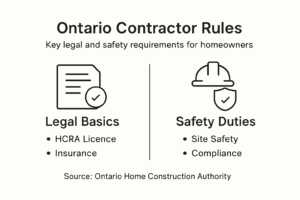
The following table outlines key Ontario legal requirements for general contractors and their impact on homeowners:
| Requirement | Contractor Obligation | Impact for Homeowners |
|---|---|---|
| HCRA Licensing | Must obtain and maintain active licence | Added consumer protection, accountability |
| Liability Insurance | Maintain active insurance policies | Financial safeguards for damages |
| Continuing Education | Complete ongoing learning | Ensures up-to-date technical skills |
| Safety Compliance (OHSA) | Implement safety protocols and training | Greater on-site safety, reduced incidents |
| Warranty Enrolment | Register homes with warranty program | Financial recourse for defects |
Pro Tip: Always request to see a contractor’s current HCRA license and verify its validity before signing any construction contracts to protect your investment and ensure legal compliance.
Key Responsibilities and Homeowner Protections
Homeowners in the Durham Region have substantial legal safeguards when engaging general contractors for residential construction projects. Homeowners possess specific rights during renovations that protect them from unethical practices, including the right to receive clear written contracts, obtain fair cost estimates from multiple contractors, and verify professional credentials before signing any agreements. These protections are designed to ensure transparency, accountability, and financial security throughout the construction process.
The Home Construction Regulatory Authority monitors contractor performance through a comprehensive licensing and complaint management system. This regulatory framework requires contractors to maintain high professional standards, demonstrate technical competence, and adhere to strict ethical guidelines. Homeowners can leverage these regulatory mechanisms to verify a contractor’s legitimacy, investigate potential misconduct, and seek resolution for any disputes that might arise during residential construction projects.
Beyond legal protections, general contractors have critical responsibilities that extend well beyond simple construction tasks. These include maintaining comprehensive insurance coverage, ensuring workplace safety, complying with local building codes, managing subcontractor relationships, and providing transparent communication throughout the project lifecycle. Successful contractors in the Durham Region understand that their role involves not just physical construction, but also building trust, managing homeowner expectations, and delivering high-quality results that meet or exceed regulatory standards.
Pro Tip: Always request and thoroughly review a general contractor’s complete documentation, including licensing, insurance certificates, and references, before initiating any residential construction project.
Common Pitfalls and Cost Considerations
Residential construction projects in the Durham Region involve complex financial dynamics that can quickly become challenging for homeowners. Contract management requires careful cost tracking to prevent unexpected budget overruns and project complications. Common financial pitfalls include inadequate communication, poorly managed change orders, and delayed approvals that can dramatically escalate project expenses and timelines.
Homeowners must understand payment structures to protect their financial interests. Experts recommend never paying more than 10% of the total project cost upfront and establishing clear milestone-based payment schedules. These strategies help mitigate financial risks by ensuring contractors remain accountable and motivated to complete work according to agreed specifications. Detailed contracts should explicitly outline payment terms, scope of work, materials to be used, and potential additional cost scenarios.
Beyond financial considerations, homeowners should anticipate potential project complexities that might impact overall costs. Unexpected structural issues, material price fluctuations, permit delays, and subcontractor scheduling challenges can all contribute to project complexity. Successful navigation of these potential obstacles requires open communication, flexible planning, and a comprehensive contingency budget that accounts for approximately 10-15% of the total project cost to address unforeseen circumstances.
Pro Tip: Create a detailed spreadsheet tracking all projected and actual expenses, maintaining a minimum 15% buffer for unexpected costs, and document every financial discussion with your general contractor.
Take Control of Your Durham Home Project with Expert General Contracting
Managing a residential construction project in Durham is a complex task that demands clear communication, strict safety compliance, and detailed workflow planning. If you are feeling overwhelmed by the challenges of coordinating subcontractors, ensuring legal compliance, or anticipating construction costs and timelines, you are not alone. Your goal is to partner with a trusted general contractor who understands local building codes, adheres to Ontario licensing requirements, and expertly navigates project complexities to protect your investment and bring your vision to life.
At Henley Contracting, we specialize in residential construction and custom builds tailored to your unique needs. With over 30 years of experience serving Durham and surrounding regions, we combine craftsmanship with transparent project management and a deep knowledge of legal and safety requirements.
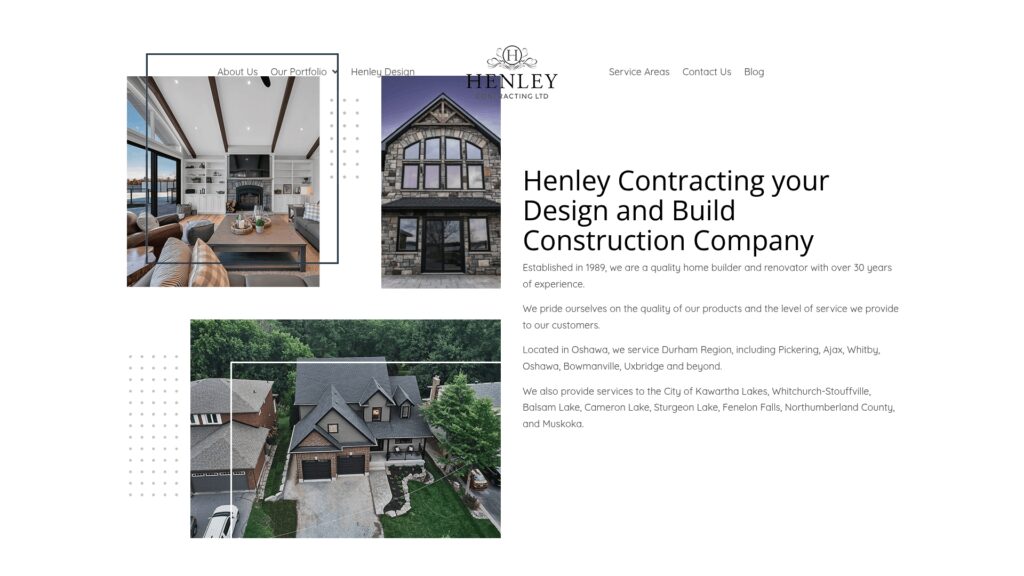
Don’t risk costly delays or unclear communication on your home renovation or new build. Visit Henley Contracting Ltd. today to explore our full range of renovation services and engineering expertise. Connect with us now to discuss how a dedicated general contractor can simplify your workflow and deliver high-quality results you can trust.
Frequently Asked Questions
What is the role of a general contractor in residential construction?
A general contractor is responsible for overseeing all aspects of a construction or renovation project, coordinating subcontractors, managing schedules, and ensuring compliance with building codes and safety standards.
How can homeowners protect themselves when hiring a general contractor?
Homeowners can protect themselves by ensuring that the contractor has a valid license, comprehensive insurance, and a good reputation. It’s important to review contracts carefully and verify credentials before starting any project.
What types of general contractors are available for residential projects?
General contractors can be categorized into several types, such as operative builders, design-build firms, remodeling contractors, and custom home builders, each with specific areas of expertise and project focus.
What should homeowners expect in terms of costs when hiring a general contractor?
Homeowners should expect clear payment structures with milestone-based schedules and should plan for potential additional costs by maintaining a contingency budget of approximately 10-15% of the total project cost to address unexpected expenses.